AUTORA: PROF. SILVINA BASCARY

AUTORA:  PROF. SILVINA BASCARY

sábado, 27 de junio de 2020

ELECTRICITY GROUNDING Actividades

Understanding Electrical Grounding in Household Wiring 

Written by 

Grounding is a principle of electricity that sometimes puzzles homeowners. In essence, the grounding system in a residential wiring system serves a "backup" pathway that provides an alternate route for electrical current to follow back to "ground" in the case of a problem in the wiring system. To understand its importance to a home wiring system, it is important to know something about the nature of electrical energy flow.
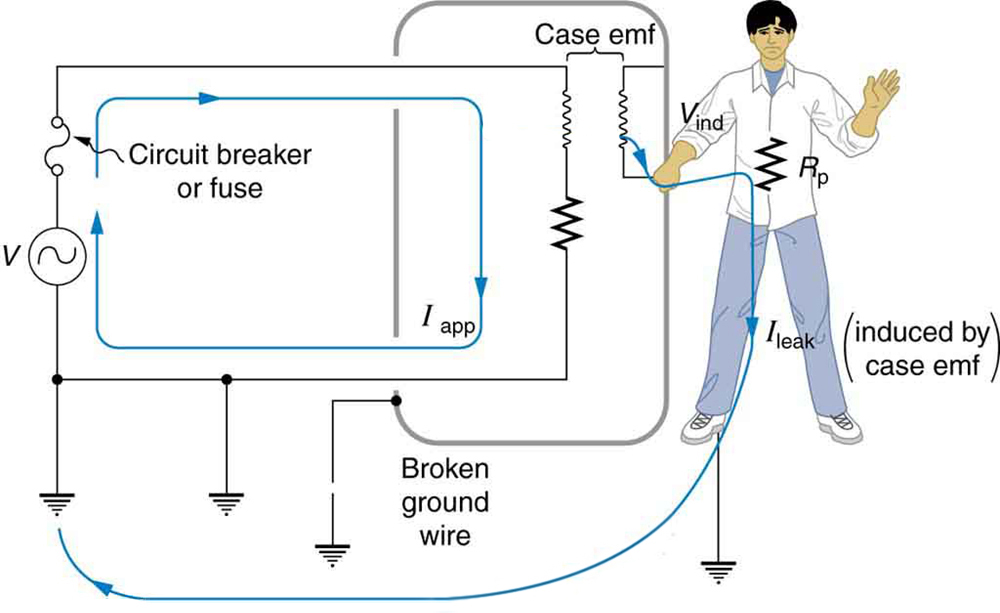

Electrical Safety: Systems and Devices – College Physics


Some Electricity Basics

The electrical current in your home's wiring system consists of a flow of electrons within metal circuit wires. The current comes in two forms, a negative and a positive charge, and this charged electrical field is created by huge generators operated by the utility company, sometimes many hundreds of miles away. It is this polarized charge than effectively constitutes the flow of electrical current, and it arrives at your home through a vast network of high-tension service wires, substations, and transformers that blanket the landscape.

The negative half of the charge is the "hot" current. In your home's wiring system, the hot current is normally carried by black wires, while the neutral wires, which are white, carry the positive charge. Both sets of wires enter your home through the utility's main service wires, run through your electrical service panel, and run side-by-side through every circuit in your home.

The physics of electrical flow are more complicated than most simple explanations can convey, but essentially, electricity seeks to return its electrons to "ground"—that is, to discharge its negative energy and return to equilibrium. Normally, the current returns to ground through the neutral wires in the electrical system. But should some breakdown of the pathway occur, the hot current may instead flow through other materials, such as wood framing, metal pipes, or flammable materials in your home. This is what may happen in a short circuit situation, where most electrical fires and shocks originate. A short circuit is when electricity strays outside the wires it is supposed to flow through—in other words, when it takes a shorter path to ground.

Available at www.thespruce.com  (Acceso el 27 de junio, 2020)

sábado, 13 de junio de 2020

LINEAR-NON LINEAR CIRCUITS Cuestionario

A) Responda el cuestionario con la información del texto.

1- ¿Con qué se construyen los dispositivos eléctricos?
2- ¿De qué habla en este artículo?
3- ¿Qué es un circuito lineal?
4- ¿Cuáles son sus parámetros?
5- ¿Qué es un circuito lineal?


B) El resto del texto será leído en clase.

What are Linear and Non-linear Circuits and Its Differences?
The electrical devices are built with the help of the linear and nonlinear components. To understand the basic design of these devices, the fundamental understanding of linear circuit and non-linear circuit are necessary. In this article, we are discussing what is a linear and non-linear circuits with its differences, elements of the linear & nonlinear circuit and some of the examples are explained.

What are Linear and Non-linear Circuits?

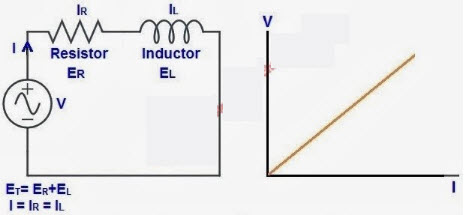
Simply we can say that the linear circuit is an electric circuit and the parameters of this circuit are resistance, capacitance, inductance and etc which are constant. Or we can say that the parameters of the circuits are not changed with respect to the voltage and current is called the linear circuit.
Linear Circuit
Linear Circuit
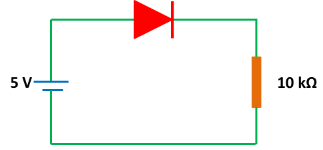
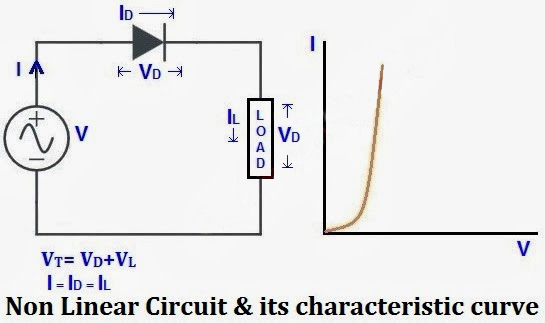
The non-linear circuit is also an electric circuit and the parameters of this circuit differ with respect to the current and the voltage. Or in the electric circuit, the parameters like waveforms, resistance, inductance and etc are not constant is called as non- linear circuit.
Non-Linear Circuit
Non-Linear Circuit

Difference Between the Linear and Non-Linear circuit

Generally, the word linear means a straight line which looks like diagonal and it has linear characteristics between voltage and current. i.e  the current flow in the circuit is directly proportional to the voltage. If there is an increase in the voltage then the current flow in the circuit also increases and vice versa. The output characteristics of the linear circuit are between current and voltage of the figure is shown below.
Linear Circuit Characteristics
In a linear circuit, the response of the output is directly proportional to the input. In the circuit, the applied sinusoidal having the frequency “f” and the output means the voltage between the two points is also having the sinusoidal frequency “f”.
In the non-linear circuit, the output characteristic is like a curve line which in between the voltage and current as shown in the following figure.
non-linear-circuit
The other difference between the linear and nonlinear circuit is solving the circuit. In the linear circuits, the solving of the circuit is a simple by using a simple technique, using a calculator to solve and by comparing with the non-linear circuit the linear circuit is easy to solve.
The solving of the non-linear circuits is complex than the linear circuit and there is a lot of data, information is required to solve the nonlinear circuits. Due to a lot of change in the technology, we can simulate and analyze the output curves of linear and nonlinear circuits with the help of the circuit simulation tools like Multisim, Matlab, and PSpice.